
EURUSD
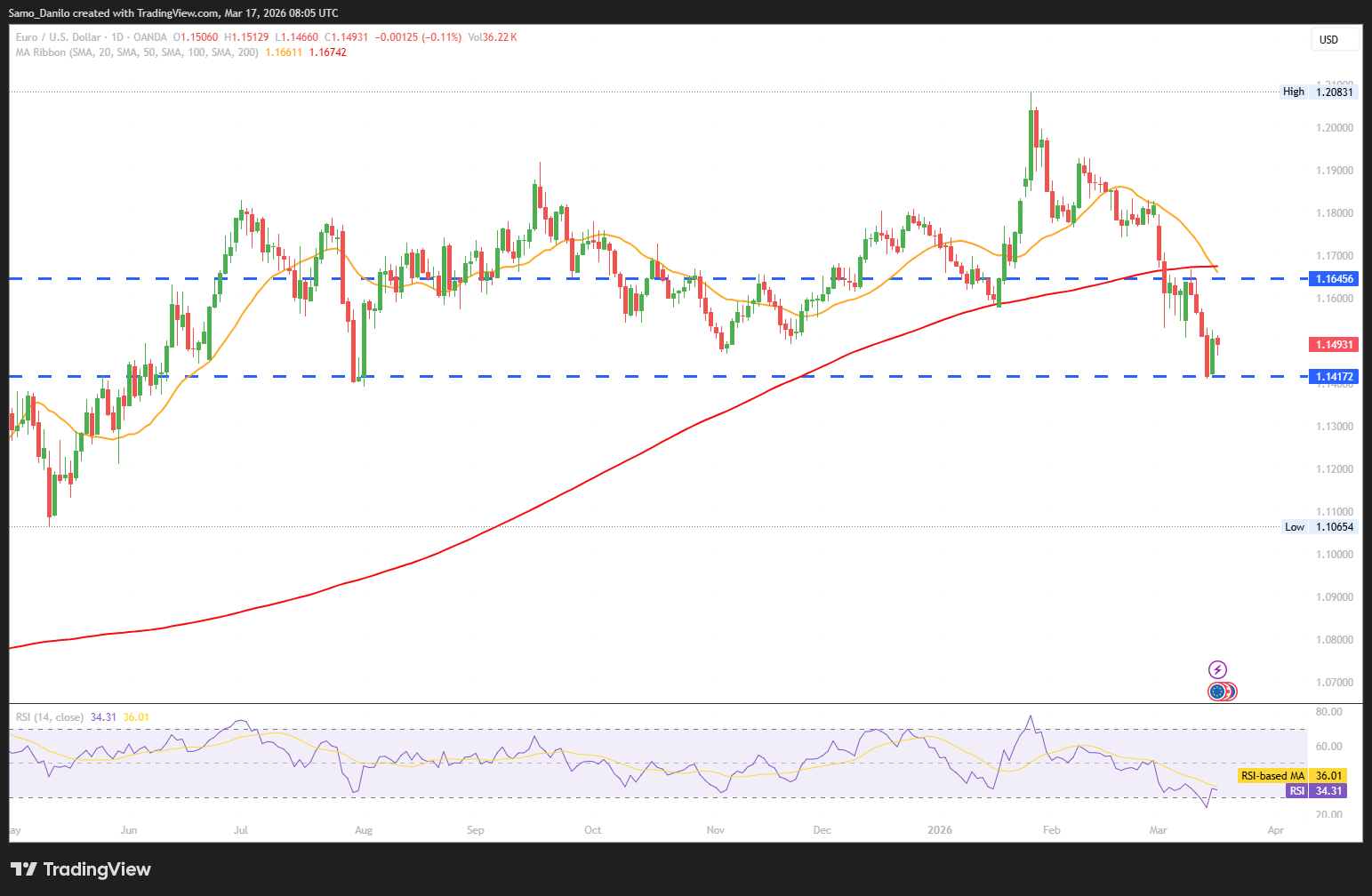
- EUR/USD Price: The EUR/USD failed to build on the previous session’s recovery and moved back below the 1.1500 level during European trading on Tuesday. The pullback reflects a firmer US Dollar and cautious market sentiment.
- ECB rate: The European Central Bank is widely expected to keep its deposit rate unchanged at 2.0% at the upcoming March meeting. However, interest rate futures indicate markets are fully pricing in a rate hike by July, with around a 55% probability of a second increase by year-end.
- ECB's Kazimir: Peter Kazimir noted that the conflict involving Iran and its inflationary impact could force the ECB to raise interest rates sooner than previously expected. Rising energy prices remain a key concern for policymakers.
- ECB's Lagarde: Investors will closely watch comments from Christine Lagarde for signals on how the ECB plans to manage inflation risks stemming from higher energy costs and geopolitical tensions affecting the Eurozone economy.
- Fed rate: The Federal Reserve is also expected to leave its benchmark interest rate unchanged within the 3.50%–3.75% range following its two-day meeting. Policy divergence expectations between the Fed and ECB could influence near-term direction in the currency pair.
| SMA (20) | Slightly Falling |  |
|
| RSI (14) | Falling | | |
| MACD (12, 26, 9) | Falling | | |
Closing statement: EUR/USD remains under pressure as markets balance ECB tightening expectations against a resilient US Dollar. Central bank guidance and energy-driven inflation risks will be key drivers in the near term.
GBPUSD
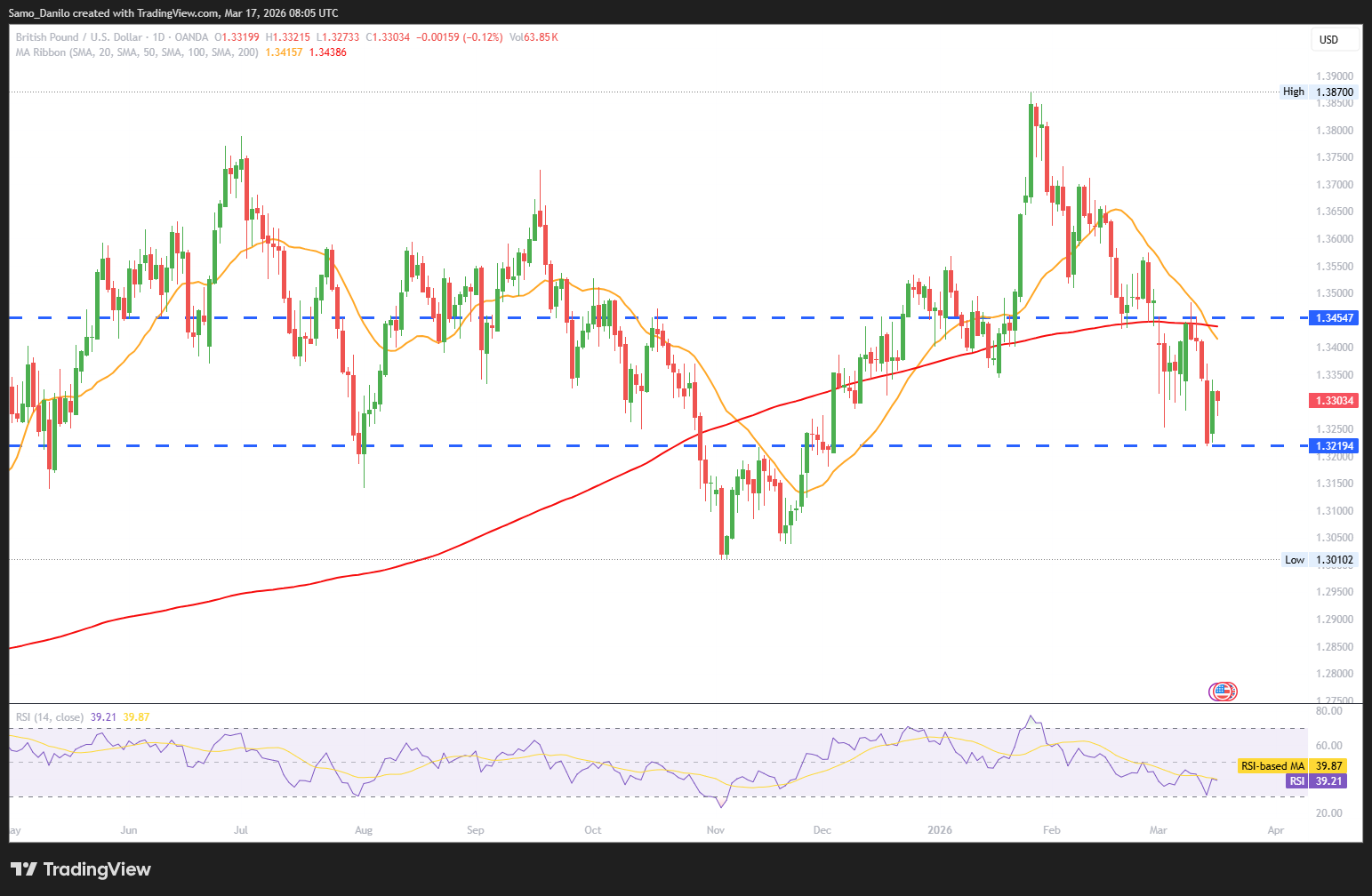
- GBP/USD Price: The GBP/USD continues to struggle for upside momentum, slipping back toward the 1.3300 level during European trading on Tuesday. The move reflects a combination of a firmer US Dollar and cautious sentiment around the UK outlook.
- BoE rate: The Bank of England is expected to keep interest rates unchanged at 3.75%, with a likely 7–2 voting split. However, rising Crude Oil prices driven by Middle East tensions are lifting inflation expectations, complicating the central bank’s policy outlook.
- UK Government: Keir Starmer stated that the United Kingdom will avoid deeper involvement in the conflict with Iran, while acknowledging that reopening the Strait of Hormuz is complex. The government is also implementing measures to address rising living costs.
- US data: Recent data from the United States showed Industrial Production rising by 0.2% month-on-month in February, slowing from January’s 0.7% increase. On an annual basis, growth also moderated to 1.4%, indicating some cooling in industrial activity.
- Labor market: Market participants are now looking ahead to upcoming UK employment figures, particularly the ILO Unemployment Rate, which is to remain steady at 5.2%. Labor market resilience will be key for future Bank of England policy expectations.
| SMA (20) | Falling | | |
| RSI (14) | Falling | | |
| MACD (12, 26, 9) | Falling | | |
Closing statement: GBP/USD remains under pressure as geopolitical tensions and inflation concerns weigh on the Pound, while upcoming UK labor data and central bank signals will be crucial for the pair’s next directional move.
XAUUSD
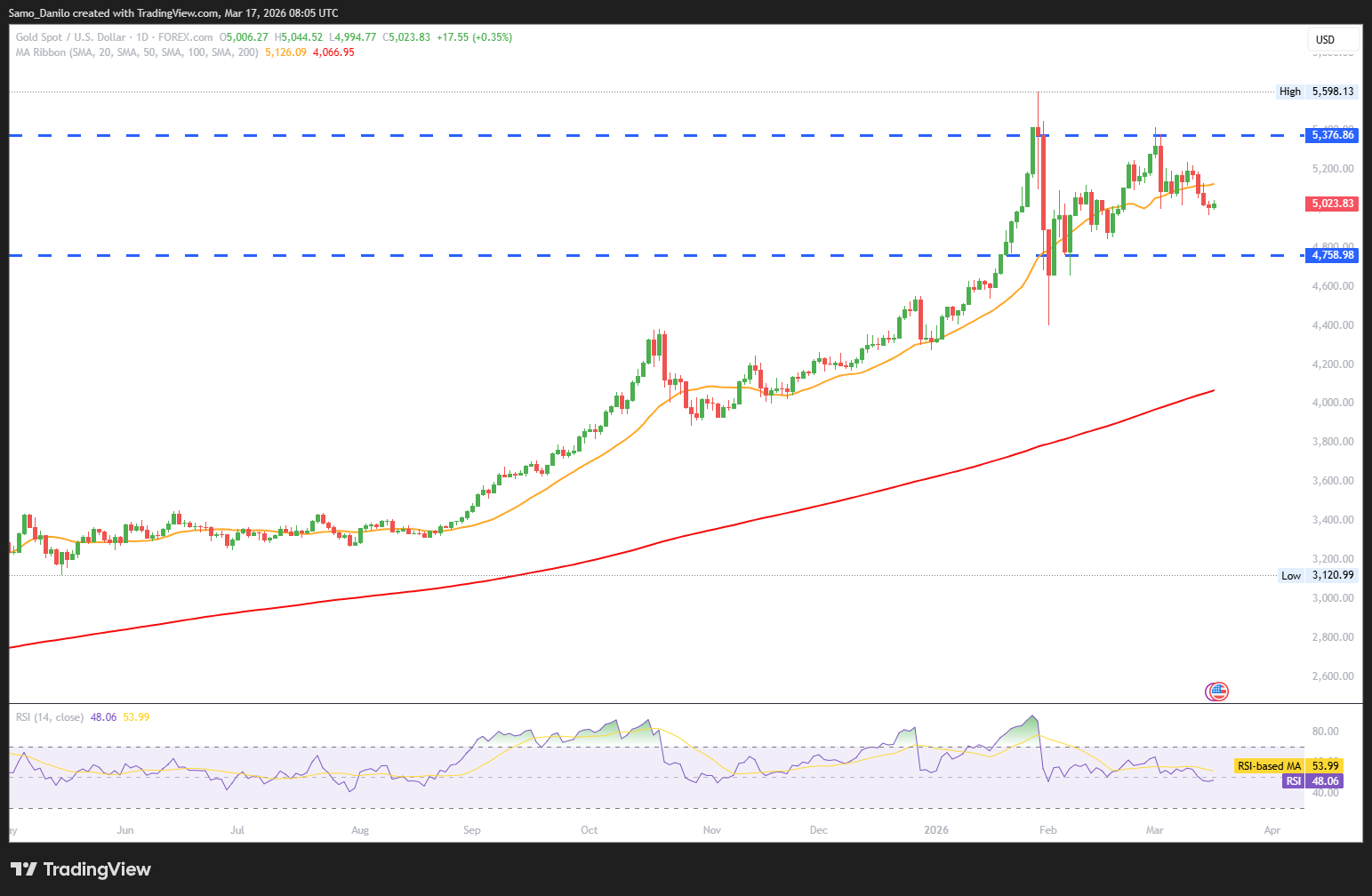
- XAU/USD Price: The XAU/USD managed to stabilize above the $5,000 psychological level after four consecutive days of losses. The resilience in Gold suggests ongoing demand for safe-haven assets amid geopolitical uncertainty.
- NATO Allies: European nations responded to pressure from Donald Trump regarding support in securing the Strait of Hormuz. Countries including the United Kingdom, Germany, Japan, and France emphasized diplomatic solutions over military action, with Friedrich Merz noting that NATO is not an intervention alliance.
- Middle East: The Israel Defense Forces announced an expansion of ground operations in southern Lebanon, targeting areas associated with Hezbollah. Ongoing conflict in the region continues to support safe-haven demand for gold.
- China visit: Donald Trump officially postponed his planned trip to China, citing the broader conflict with Iran. Meanwhile, Scott Bessent clarified that the delay was not directly linked to developments in the Strait of Hormuz.
- US-China: Li Chenggang indicated that China and the United States have agreed to maintain stable tariff levels despite recent adjustments. However, concerns remain over new Section 301 investigations, which could reignite trade tensions.
| SMA (20) | Rising |  | |
| RSI (14) | Falling | | |
| MACD (12, 26, 9) | Slightly Rising | |
Closing statement: Gold is holding firm above key support levels as geopolitical risks and trade uncertainties sustain safe-haven demand, though broader macro developments and central bank expectations will continue to influence price direction.
CRUDE OIL
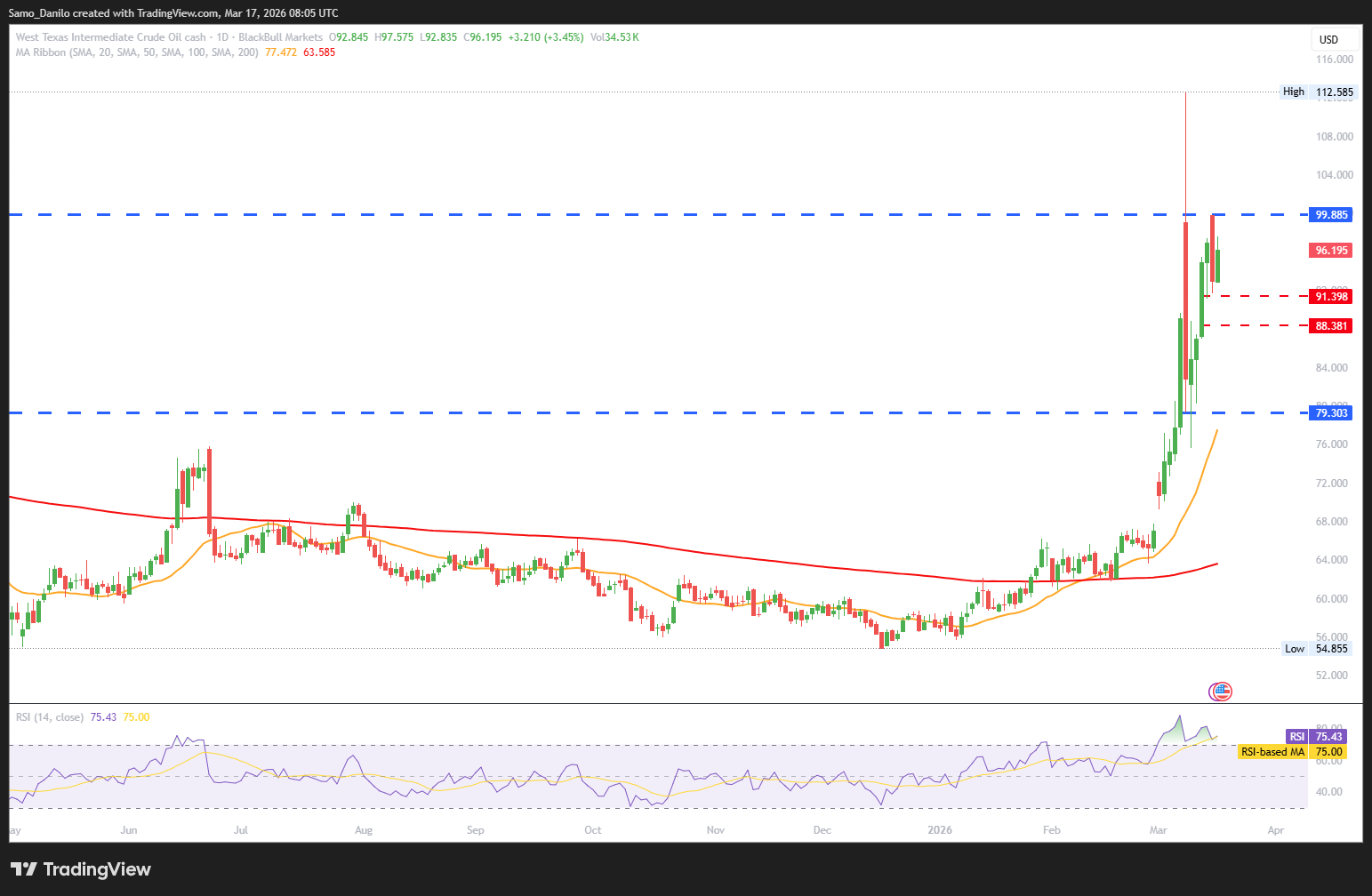
- Crude Oil Price: The Crude Oil market rallied sharply in Asian trading, with prices holding near $196 per barrel. The surge reflects extreme supply fears tied to the escalating conflict involving the United States, Israel, and Iran.
- Energy infrastructure: Iran has reportedly targeted key oil and gas facilities across the region, including strikes on the Shah Gas Field in the United Arab Emirates and incidents in the Fujairah Oil Industry Zone. A tanker near the port of Fujairah was also hit, intensifying fears of widespread disruption to energy flows.
- Energy supply: Countries across Asia are actively seeking alternative energy sources as supply risks grow. Nations such as Thailand, the Philippines, and New Zealand are reportedly considering increased imports of oil from Russia.
- Strait of Hormuz: The Strait of Hormuz remains largely disrupted, a critical issue given its importance as a global oil chokepoint. Donald Trump has urged China to help reopen the passage, though Beijing has so far remained publicly silent.
- Fuel prices: Retail fuel costs are rising rapidly, with US diesel prices surpassing $5 per gallon, according to GasBuddy. This marks only the second time such levels have been reached, highlighting the global economic impact of the supply shock.
| SMA (20) | Rising | | |
| RSI (14) | Rising | | |
| MACD (12, 26, 9) | Rising | | |
Closing statement: Crude oil prices are being driven sharply higher by direct attacks on energy infrastructure and disruptions in key shipping routes. With supply risks intensifying and global demand scrambling for alternatives, the oil market remains highly volatile and structurally tight in the near term.
DAX
- DAX Price: The DAX is trading around 23,500 points and is expected to open cautiously on Tuesday. Slightly higher Crude Oil prices are weighing on sentiment, as energy costs remain a key risk for European equities.
- Economic sentiment: Investors are awaiting the March release of the ZEW Economic Sentiment Index, which provides insights into economic expectations in Germany. While recent data showed improvements in current conditions, forward-looking expectations have softened slightly.
- Germany involvement: Friedrich Merz*stated that Germany will not participate in the conflict involving Iran or in efforts to secure the Strait of Hormuz. The stance highlights Europe’s cautious geopolitical positioning.
- US-China: Donald Trump has requested to delay his planned visit to China, citing the ongoing conflict in the Middle East. The postponement risks reigniting tensions between the United States and China, already strained by trade disputes and geopolitical issues.
- Daimler Truck: Daimler Truck received a reaffirmed “Outperform” rating and €50 price target from RBC Capital Markets. The upgrade follows stronger-than-expected 2025 results, including solid orders, margins, and free cash flow performance.
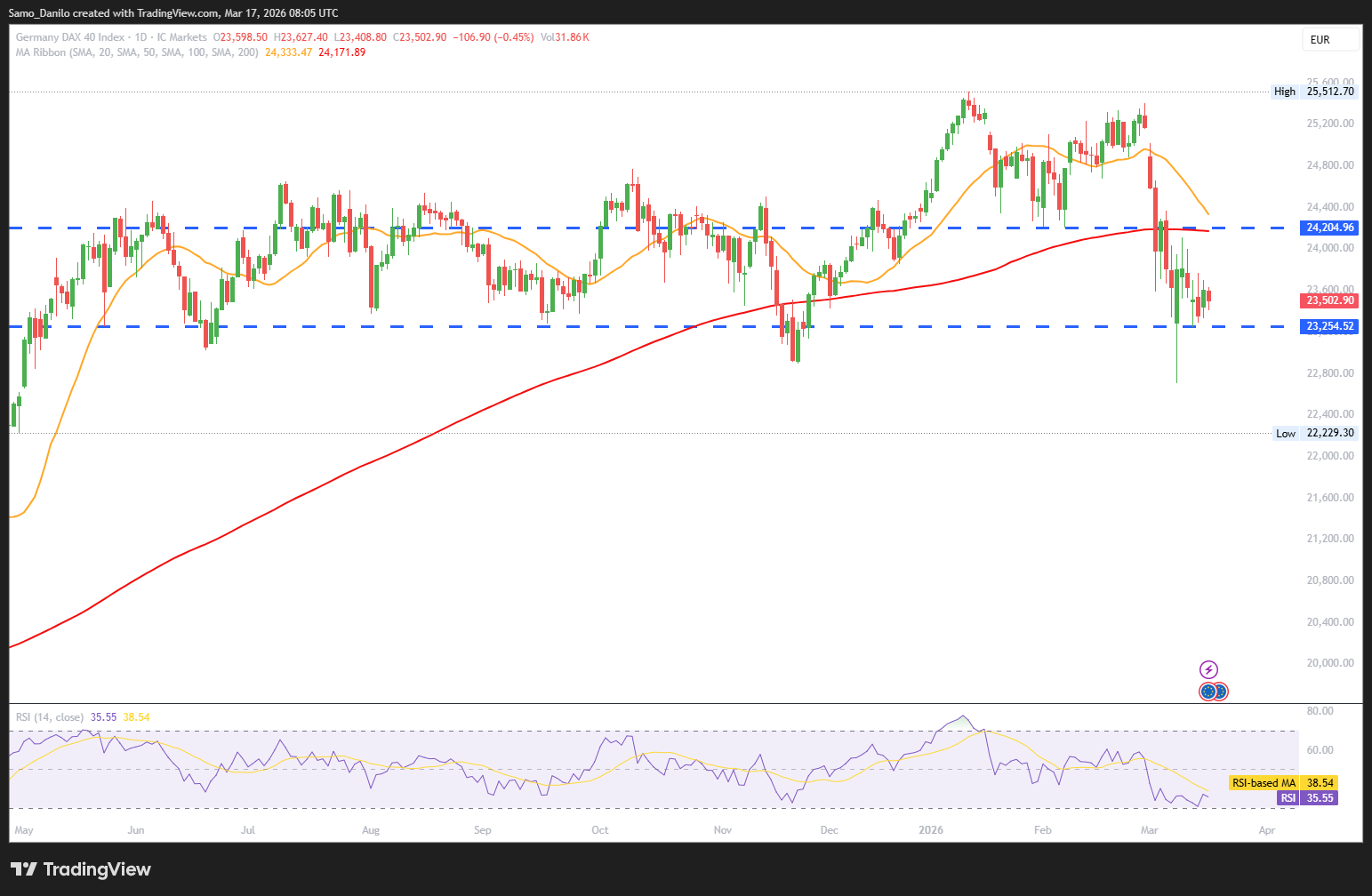
| SMA (20) | Falling | | |
| RSI (14) | Falling | | |
| MACD (12, 26, 9) | Falling | | |
Closing statement: The DAX remains sensitive to energy price movements and geopolitical developments, while economic data and corporate performance continue to provide mixed signals for the index’s near-term direction.